Implementing a proven contractor business growth system is the most effective way for home service business owners to streamline daily operations, empower field technicians, and sustainably scale revenue. Navigating the residential service industry, encompassing HVAC, plumbing, and electrical trades, presents distinct challenges for independent operators seeking scalable expansion. While technical tradespeople possess high-level mechanical skills, scaling a business from a local service footprint into a multi-million-dollar enterprise requires operational alignment, reliable client data, structured dispatch workflows, and standardized communication.
Leveraging a Contractor Business Growth System for Scalable Operations
Many specialty trade business owners reach a plateau where manual tracking and disorganized customer management prevent further expansion. Transitioning away from fragmented spreadsheets toward an integrated contractor business growth system enables service businesses to stabilize daily operations, clarify performance metrics, and build repeatable processes across every department.
The primary obstacle to contractor growth is often operational drag—spending excessive hours re-entering manual field notes, tracking jobs ad-hoc, and managing dispatching without structured routines. Implementing a comprehensive framework resolves these operational bottlenecks by providing real-time visibility into workforce metrics and customer activity. According to data on the U.S. Bureau of Labor Statistics Specialty Trade Contractors Industry Overview, specialty trade contractor employment represents millions of workers across residential and commercial sectors. Managing trade teams effectively requires structured systems that allow managers and field personnel to coordinate seamlessly. Managing trade teams effectively requires structured systems that allow managers and field personnel to coordinate seamlessly.
Adopting a dedicated contractor business growth system provides the essential infrastructure needed to unify these teams and drive long-term profitability.
Real-World Case Study: Hudson Plumbing’s Operational Transformation
To see how operational structure impacts revenue and business trajectory, consider the experience of Hudson Plumbing. Before transitioning to a structured operational model, the organization operated primarily as a standard service contractor carrying out general plumbing, remodeling, and excavation work.
Kedge, the service manager at Hudson Plumbing, highlighted the initial friction the company faced prior to implementing dedicated management tools:
“Before we had CertainPath Software, some of the biggest challenges would be collecting of the data and having customer history so that we would be able to serve our clients the best.”
The absence of historical client data and centralized tracking created significant administrative burdens. Technicians frequently operated without prior context on jobsites, while management spent valuable time performing repetitive manual tasks.
Streamlining Day-to-Day Operations
Integrating centralized software transformed daily operations across the organization. By consolidating client history, technicians gained clear visibility into past repairs and installations right at the customer’s home.
“The CertainPath software has simplified things for us on the day-to-day,” Kedge noted. “Now we have the data in front of us… Our technicians are able to see the history of what we’ve done at the customer’s house. It has allowed us to focus on things that we were probably missing out because we were spending so much time doing the manual aspect of it.”
Beyond software, aligning operational procedures allowed the dispatch team to adopt standard scripts, ensuring consistent customer communication at every touchpoint. This level of operational consistency is a hallmark of a successful contractor business growth system.
Measuring Financial Impact
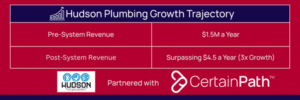
The shift toward structured processes produced significant financial results for Hudson Plumbing:
Historical Baseline: Before joining CertainPath, the company generated roughly $1.5 million in annual revenue.
Scaled Growth: Following system implementation, revenue expanded, putting the business on track to surpass $4.5 million annually.
3x Growth Trajectory: By reducing administrative friction and equipping team members with a shared operational framework, Hudson Plumbing tripled its total output while maintaining quality service.
Kedge highlighted how team alignment supported this trajectory:
“I think that we all understand our goals better. We understand our purpose better… I think another thing that kind of gets overlooked a lot is we all start speaking the same language. When you’re speaking the same language, it seems like things go a lot better on a day-to-day basis.”
Core Capabilities of a Contractor Business Growth System
To replicate these results, service business leaders must focus on core operational elements that drive predictable growth:
For additional economic background on home service market expansion, explore the IBISWorld Industry Research Reports for detailed data on HVAC, electrical, and plumbing industry performance across the United States.
Implementing Systems for Sustainable Business Growth
Sustained growth requires moving away from reactive problem-solving toward proactive operational management. When trade businesses combine clear workflows with specialized software and team alignment, they eliminate administrative bottlenecks and position themselves for long-term scalability.
To discover how structured coaching, community, and business software can help scale your residential service business, visit CertainPath.