
Pricing is one of the most important and misunderstood parts of running a successful HVAC business. If you’re a contractor who prices jobs accurately, you can build a sustainable, profitable company. If you don’t take the time for accurate pricing, though, you may struggle with cash flow, razor-thin margins, and constant pressure to win the next job just to stay competitive and keep your company running.
Unfortunately, too many HVAC contractors fall into one of two traps when they’re unclear how to price HVAC jobs. Some rely on rough estimates based on past jobs or competitor pricing, and others set prices based on what they think customers will pay. Neither one of these approaches guarantees any real profitability for your company. If you want to know how to estimate HVAC jobs the right way, our HVAC pricing guide for contractors can help.
Here’s what you need to know about how to price HVAC jobs for maximum profit and long-term stability, including the average HVAC service prices in 2025, the most common HVAC pricing models, and how to calculate job costs step by step. It’s also critical to understand profit margin and markup strategies, how to build a professional HVAC price book, factors that affect HVAC pricing, and tips for creating accurate estimates.
With all that knowledge, you’ll have a practical framework for confidently pricing jobs, protecting your margins, and growing your HVAC business predictably.
What Are Average HVAC Service Prices in 2026?
Understanding average HVAC service pricing helps contractors like you benchmark their rates against the broader market. However, these figures should be viewed as reference points, not actual targets when you’re pricing HVAC services.
That’s because every HVAC business has different overhead, labor and material costs, service quality, and market conditions, so your pricing should reflect your actual costs and the value you deliver, not just match competitors.
Here are some of the most common price ranges for HVAC services in 2026.
Common HVAC Repair Costs
- AC repair: $150 to $450
- Furnace repair: $125 to $355
- Thermostat replacement: $120 to $350
- Capacitor replacement: $120 to $300
- Refrigerant recharge: $200 to $700 (depending on refrigerant type)
HVAC Installation and Replacement Costs
- Air conditioner installation: $3,800 to $7,500
- Furnace replacement: $2,700 to $6,400
- Heat pump installation: $4,200 to $7,300
- Mini-split installation: $2,000 to $5,000 per zone
These ranges vary widely depending on several factors, including the geographic region, equipment brand and efficiency rating, home size and system capacity, any ductwork modifications, and your labor costs and business overhead.
Most importantly, average prices should never drive your pricing strategy. If your real costs require higher prices to maintain healthy margins, charging less just to match the market can quickly lead to financial problems. Remember, your pricing must always start with your costs, not someone else’s. It can be tempting to match or even undercut the competition, but that can quickly lead to issues for your HVAC business if it means you’re actually losing money on your services.
HVAC Pricing Models: Choosing the Right Approach
HVAC contractors typically use one of three pricing models when quoting jobs, which are flat-rate pricing, time and materials (hourly) pricing, and hybrid pricing. Each one of these approaches has advantages and limitations, so the best choice often depends on the specific type of work you’re performing and the HVAC pricing strategy you want to run consistently.
Many successful HVAC companies use a hybrid approach, meaning that they combine flat rates for routine work with hourly pricing for complex jobs.
Flat-Rate Pricing
Flat-rate pricing means charging a fixed price for a service regardless of how long the job takes. For example, replacing a capacitor might be listed as $220 in your price book, and whether that job takes 20 minutes or 45 minutes, the customer pays the same price. This model works best for predictable, repeatable services like seasonal maintenance visits, capacitor replacement, thermostat installation, and standard equipment installations.
Flat-rate pricing helps customers know the price upfront, which makes it easier to approve work. Additionally, clear pricing reduces hesitation and speeds up decision-making, and technicians who work efficiently complete more jobs per day without reducing your revenue.
However, flat-rate pricing also carries a risk. If you underestimate the complexity of the job, your technicians may spend significantly longer than expected to complete it, and that reduces your profit. That’s why flat-rate pricing works best when contractors have accurate historical job data to draw from, so they have the best chance of estimating accurately.
Time and Materials (Hourly) Pricing
Time and materials pricing charges customers based on the actual labor time required plus the cost of materials. For example, your HVAC pricing guide for a job might include $125 per hour for labor as your hourly labor cost and $180 in parts, so the total cost of the job depends on how long it takes. This is an ideal model for work where the scope is difficult to predict.
Typical examples for using this model include things like diagnostic troubleshooting, complex system failures, custom installations, emergency repairs, and multi-system problems. The biggest advantage of hourly pricing is risk protection, because a job that takes longer than expected has the additional labor time billed accordingly.
However, hourly pricing has some drawbacks, with the biggest one being that customers hesitate to approve work without knowing the final cost. It also requires careful tracking of labor time to ensure accurate billing, so customers aren’t over or undercharged, and your HVAC business is compensated fairly.
Hybrid Pricing
Hybrid pricing combines the best elements of both systems, which is why so many successful HVAC companies use it. They have flat-rate pricing for routine services and hourly pricing for complex or unpredictable work. As an example, consider using flat-rate pricing for tune-ups, capacitor replacements, thermostat installations, and standard equipment installs. Then, switch to hourly pricing for diagnostics, multi-system troubleshooting, custom ductwork, emergency calls, and related issues.
You may also want to include a service call fee, which often ranges from $70 to $200 and helps cover your travel time, the initial inspection, and administrative overhead. Hybrid pricing gives you flexibility while maintaining consistency for your commonly offered services.
How to Calculate HVAC Job Costs Step by Step
Accurate pricing starts with one essential formula: Total Job Cost = Labor + Materials + Overhead. Every one of your profitable HVAC quotes should begin with this calculation, and guessing costs or relying on rough estimates can quickly lead to losses. Here’s how all the components play a role in determining the final price.
Calculating Labor Costs
Labor costs include much more than hourly wages, and you’ll need to account for the fully loaded labor rate, also known as labor burden.
This includes:
- Base hourly wage
- Employer payroll taxes
- Workers’ compensation insurance
- Health benefits
- Paid time off
- Training costs
- Non-billable time
For example, if your base technician wage is $22 per hour as the HVAC technician’s hourly salary and the labor burden is 20%, your fully loaded labor rate is $22 x 1.20, or $26.40 per hour. If a job requires 6 hours of labor, your total labor cost would be 6 x $26.40, or $158.40. Many HVAC contractors then apply a 20 to 30% markup on labor to ensure profitability. Without accounting for the full labor burden, you might underestimate costs and unknowingly reduce your profit margin.
Calculating Material Costs
Materials include all equipment, components, and consumables required to complete the job, and accurate material estimates require a complete job assessment. You should inspect the job site whenever possible, build a complete materials list, and confirm current supplier pricing. HVAC material costs can fluctuate significantly, particularly for items like refrigerant and equipment components.
Materials may include:
- HVAC equipment (furnaces, condensers, heat pumps)
- Replacement parts
- Ductwork components
- Electrical components
- Refrigerant
- Adhesives and fittings
- Filters and mounting hardware
Missing even small items can reduce your profitability significantly, especially on large installation jobs.
Calculating Overhead Costs
Overhead includes the expenses required to run your HVAC business that aren’t tied to a specific job, and common overhead expenses include:
- Office rent or mortgage
- Utilities
- Vehicle leases, fuel, and maintenance
- Business insurance
- Marketing and advertising
- Office staff salaries
- Software tools and subscriptions
- Licensing and certification fees
To allocate overhead properly, you’ll need to divide monthly overhead by billable labor hours. In other words, Monthly Overhead / Monthly Billable Hours = Overhead Cost Per Hour. Here’s an example:
If your monthly overhead is $8,000, and you have 200 billable hours, $8,000 / 200 means $40 in overhead per billable hour. If a job takes 6 labor hours, that’s 6 x $40, or $240 in overhead allocation. Including your overhead ensures that every job contributes to the cost of running your business.
Setting Your Profit Margin and Markup
Many HVAC contractors confuse markup and profit margin, but they aren’t the same, and understanding the difference is essential for accurate pricing. Markup is the percentage added to the cost to determine the price, while your profit margin is the percentage of the final price that becomes profit.
For example, if a job costs $1,000 and you charge $1,250, your markup is 25%, while your profit margin is likely closer to 20%. Healthy HVAC businesses typically aim for 20 ot 25% net profit margins, using a basic pricing formula of Final Price = (Labor + Materials + Overhead) x (1 + Markup %).
Applying Markup to Materials and Labor
Many HVAC contractors apply different markup rates to materials and labor, with typical ranges being 20% to 50% markup for materials and 20% to 30% markup for labor.
A full pricing example might look like this:
- Labor: $1,200
- Materials: $3,600
- Overhead allocation: $500
Total job cost: $1,200 + $3,600 + $500 = $5,300. If you’re looking to achieve a 25% profit margin, the final price would be approximately $7,067. It’s essential to double-check the final margin after applying the markup to ensure it aligns with your profitability goals.
Including Taxes in Your Pricing
Taxes are another important component of HVAC pricing, and most contractors handle sales tax by listing it as a separate line item on estimates and invoices. This approach offers several advantages, including clear pricing transparency, easier accounting, and simplified adjustments if the tax rates change.
Another option is building tax directly into your base pricing, but this can complicate accounting and reporting. Regardless of the approach you choose, it’s essential to consult an accountant to ensure your tax handling complies with state and local regulations. You don’t want to end up with fines or other penalties.
Building Your HVAC Price Book
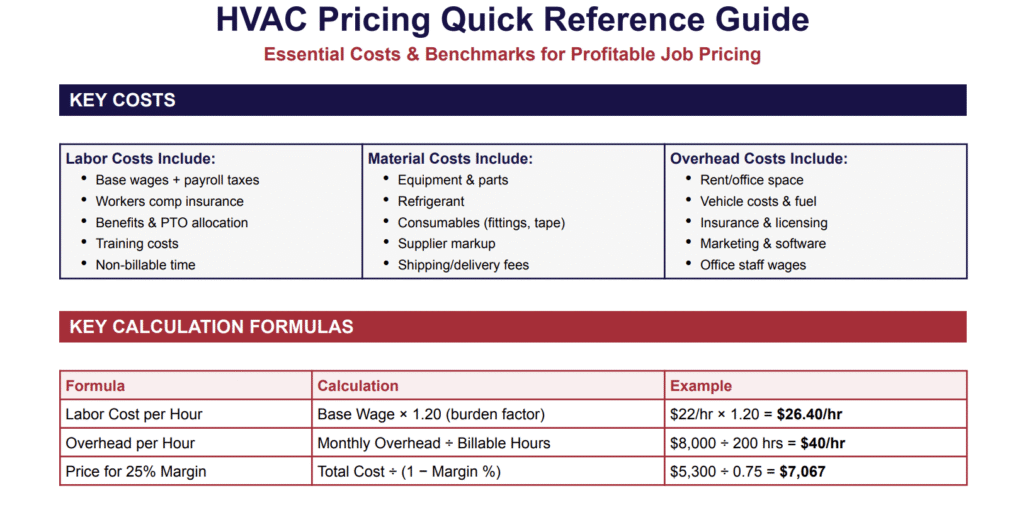
A professional HVAC business should never rely on memory or guesswork when quoting jobs, and that’s where a price book becomes essential. An HVAC price book is a standardized list of services, parts, and pricing used by technicians when creating estimates, and it helps with consistent pricing across technicians, faster job quoting in the field, protection against underbidding, and better margin control.
It also improves professionalism and customer confidence. If you’re looking for a starting point, you can download our free HVAC Pricing Quick Reference Guide, which includes formulas, markup calculations, and pricing benchmarks.
What to Include in Your Price Book
To make a complete HVAC price book, you should include several categories, including:
- Service call fees (standard service call pricing and after-hours diagnostic rates)
- Flat-rate repair pricing (organized by complexity, such as minor repairs, moderate repairs, and major component replacements)
- Installation pricing tiers (standard efficiency systems, mid-range efficiency systems, and premium high-efficiency systems)
- Maintenance plans (annual service agreements and preventative maintenance packages)
- Indoor air quality add-ons (UV lights, air purifiers, humidifiers, and high-efficiency filters)
A well-organized price book helps your technicians present options quickly and confidently during all their service calls.
Updating Your Prices Regularly
Pricing should never be treated as “set and forget” because costs change constantly, and failing to update prices can gradually shrink your margins. To avoid that, make sure you review pricing at least once per year and update prices semiannually if you’re in a volatile market. Also, adjust prices immediately when supplier costs rise, so you don’t lose profit.
Tracking job profitability is another key step, and if your margins begin shrinking despite steady pricing, it’s a sign your costs have increased and your price book needs adjustment.
Factors That Affect HVAC Job Pricing
Not all HVAC jobs are created equal, and several variables can significantly increase your complexity and labor time. Fortunately, recognizing these factors helps you price your jobs accurately from the start.
Older systems, for example, often require additional diagnostic time and harder-to-find parts, as corrosion, outdated components, and compatibility issues can all increase labor time. Some HVAC systems also have accessibility challenges and are located in difficult areas like tight crawl spaces, attics with limited clearance, rooftops, and mechanical closets, which increase labor time and safety considerations.
Emergency and after-hours service also matters, and nights, weekends, and holidays often require premium pricing. Many HVAC contractors apply 1.5x to 2x multipliers for emergency calls to compensate for their technicians’ time.
Tips for Creating Accurate HVAC Estimates
Accurate estimates protect your profits while helping customers feel confident approving work, and several best practices can improve your estimating process. First, perform a site visit. Complex installations should always include an in-person inspection whenever possible, since this lets your technicians identify potential complications before giving a quote.
Then, offer the customer multiple options. Presenting “good, better, best” options gives customers flexibility while increasing your average ticket size, so everyone benefits. To do this, you could suggest a standard system replacement (good), a high-efficiency upgrade (better), or a premium system with add-ons (best).
You should also use professional estimating tools, since modern estimating software or standardized templates ensure no cost component is overlooked. They also create professional-looking quotes that improve customer trust, so you can get additional jobs and grow your HVAC company more easily.
Take Control of Your HVAC Pricing Today
Accurate pricing is the difference between a thriving HVAC business and one that’s constantly struggling to make payroll. When you understand your costs, apply consistent formulas, and maintain clear pricing systems, you can build a business that grows year after year. The strategies in our guide provide a practical foundation for profitable pricing, so you can apply strategic markups and build a structured price book to quote jobs with confidence.
If you’re ready to simplify your pricing process, download our free HVAC Pricing Quick Reference Guide. This one-page resource includes the essential formulas, markup calculations, and pricing benchmarks every HVAC contractor needs to build a profitable pricing system.
Do you want to grow your HVAC business more easily and take it further than you thought was possible? Get started today by becoming a member, so you can explore training and resources through us at CertainPath. We’ll teach you how to price HVAC jobs, how to find the right technicians, and so much more, so you can turn your business into a thriving company for the long-term.
Frequently Asked Questions
What is a good profit margin for HVAC contractors?
A healthy HVAC business typically targets 20% to 25% net profit margin, which ensures the company can cover expenses, invest in growth, and maintain financial stability.
Should I use flat-rate or hourly pricing for HVAC jobs?
Most HVAC companies benefit from a hybrid pricing model, since flat-rate pricing works well for routine repairs and maintenance, while hourly pricing is better for complex diagnostics and unpredictable jobs.
How do I calculate my overhead cost per hour?
Divide your monthly overhead expenses by your total monthly billable hours. For example, $8,000 monthly overhead / 200 billable hours = $40 overhead per hour.
What markup should I add to HVAC materials?
Typical material markups range from 20% to 50%, depending on the part, supplier pricing, and market conditions.
How often should I update my HVAC prices?
Most contractors should review pricing annually and update it every 6 to 12 months, but rapid supplier price increases may require more frequent updates.
What should I include in an HVAC service call fee?
Service call fees typically cover travel time, an initial system inspection, basic diagnostics, and administrative overhead, with most fees ranging from $70 to $200.
How do I price emergency or after-hours HVAC calls?
Emergency calls are typically priced using a 1.5x to 2x multiplier to compensate for overtime labor and technician availability.
What’s the difference between markup and profit margin?
Markup is the percentage added to the job cost to determine price, and profit margin is the percentage of the final price that remains as profit after all costs are paid.